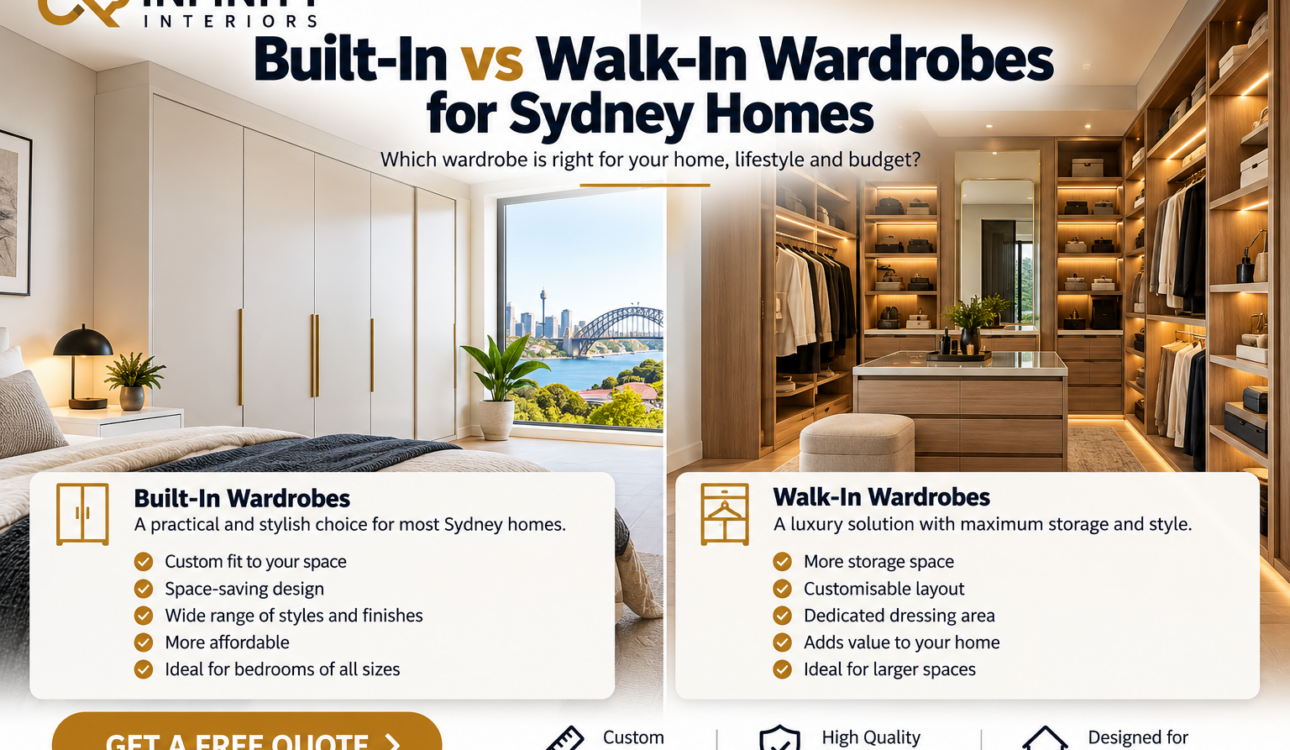
A wardrobe is one of the few things you use every single day, so getting the layout right matters more than most people expect. The choice usually comes down to two options: a built-in wardrobe set into the wall, or a walk-in that uses a dedicated space. Here's how they compare for Sydney homes on cost, space, storage and resale.
The quick answer
- Choose a built-in wardrobe if you want to maximise storage without sacrificing floor space — ideal for apartments, kids' rooms and standard-sized bedrooms.
- Choose a walk-in wardrobe if you have the room to spare and want a dressing-room feel with open, flexible storage.
Both can be fully customised. The right one depends on your floor plan and how you like to get dressed in the morning.
Built-in wardrobes: the space-saver
A built-in sits flush against or recessed into the wall, so it takes up almost no usable floor space. That makes it the practical winner in most Sydney bedrooms, where square metres are at a premium.
- Fits tight and awkward spaces — sloped ceilings, nooks, narrow walls.
- Sliding or hinged doors keep everything hidden and dust-free.
- Lower cost than a walk-in for the same amount of storage.
- Strong resale appeal: buyers expect built-ins in modern homes.
Our built-in wardrobes are designed around your exact wall, with internal fit-outs — drawers, shelving, hanging zones and shoe racks — tailored to what you actually own.
Walk-in wardrobes: the dressing room
A walk-in is a separate space you step into, lined with open shelving, hanging rails and drawers. It's the luxury option — but it only makes sense if you can give up the floor area.
- Open, easy-to-see storage and a premium feel.
- Room to add a mirror, seating or an island.
- Highly desirable in master suites and larger homes.
Trade-off: a walk-in needs roughly 4m² or more to work well. In a smaller bedroom, that floor space is usually better spent on a built-in with the same (or more) storage behind doors.
Cost comparison
As a general guide, a built-in wardrobe costs less than a walk-in of equivalent quality, because the walk-in uses more materials and takes a bigger footprint to fit out. But the bigger cost driver for both is the internal joinery — the drawers, soft-close runners, pull-outs and finishes — not the doors. That's where tailoring the fit-out to your needs keeps the budget sensible.
Which adds more value at resale?
In Sydney's market, well-built storage sells. A quality built-in reads as a practical, move-in-ready feature in any bedroom. A walk-in adds a premium, aspirational feel in a master suite. Neither is wasted spend when it's built properly — poorly finished, flimsy wardrobes are what buyers notice. Because both are custom joinery at heart, build quality is what carries the value.
How to decide
Measure your room first. If giving up 4m²+ of floor still leaves you a comfortable bedroom, a walk-in is on the table. If not, a built-in will give you more usable storage for less. Still unsure? We'll assess your space during a free in-home visit and show you both options to scale.
Want the right wardrobe for your room? Call 0415 915 915 or book a free in-home measure and quote. We design, build and install custom wardrobes across Sydney.
Book a free quoteFrequently Asked Questions
Is a built-in or walk-in wardrobe cheaper?
A built-in is usually cheaper for the same storage, because a walk-in needs more floor space and materials to fit out. For both, the internal joinery and hardware drive most of the cost.
How much space does a walk-in wardrobe need?
As a rule of thumb, around 4m² or more to be comfortable to move in and fit out properly. Below that, a built-in generally gives you more usable storage.
Do built-in wardrobes add value to a home?
Yes. Quality built-in storage is a practical, expected feature in modern Sydney homes and reads well with buyers, provided it's well made and finished.
Can you build a wardrobe into an awkward or sloped space?
Yes — that's the advantage of custom. We build around sloped ceilings, nooks and narrow walls so no space is wasted.